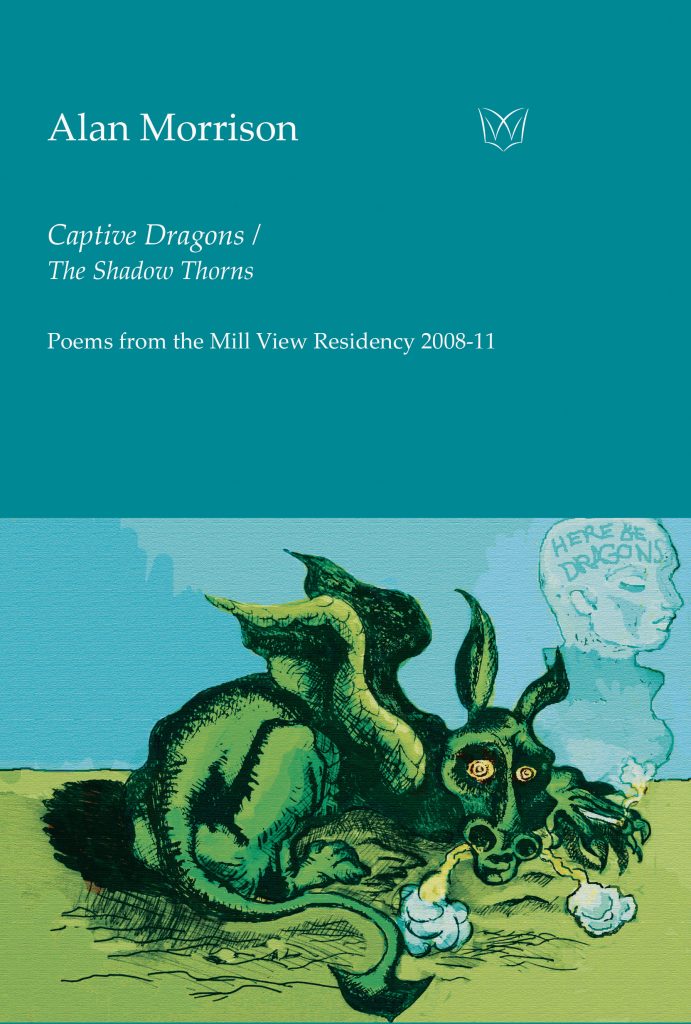
Captive Dragons / The Shadow Thorns – Poems from the Mill View Residency 2008-11 | Waterloo Press | 138pp | ISBN 978-1-906742-39-3
part-funded by Sussex Partnership NHS Foundation Trust Can be ordered here
Download a sample from the book here
From 2008 to 2011, Morrison was poet-in-residence at Mill View psychiatric hospital in Hove… He was then commissioned to write his own poetic response to his residency, the key work of which is the epic title poem Captive Dragons, a Laingian testament to the vastly nuanced subject of ‘mental illness’; its personal and social aetiologies, private and public implications, and the stigmas still tacitly attached to it today. Morrison’s core dialectical motif is the ancient phrase Here Be Dragons, once used on old maps to warn of possible dangers in unexplored regions: Morrison juxtaposes this with the relatively unmapped right hemisphere of the human brain, thought to be the source of not only psychiatric pathologies, but also the primal creative impulses which hold promise for their future illuminations.
’Alan Morrison has written the ultimate spearheading long poem to defend poetic reality, often clinically diagnosed as madness, but in fact pushing dimensions out into the retrieval of a reclaimed poetics. In a brilliantly impacted, rich diction fused to a profoundly humanitarian sensibility, he has succeeded in writing the most sustained poem about crossing frontiers of altered consciousness that I personally have encountered. He deserves our thanks.’ Jeremy Reed
‘This is a compassionate as well as a ferociously intelligent writer…. These Cantos are pretty much blank verse and are filled with wide erudition, splendid, tongue-twisting wordplay and alliteration, where the thinking is allied to pleasure in language and an increasing sense of angry reasoning which builds as a powerful response to notions of sanity and madness as a critique of our whole social order. This is R.D. Laing for the new century and its arguments are coherent as well as being emotionally responsive. In terms of Morrison’s formal devices I can only say that this magnificent and beautifully designed work reads like a coming together of Milton and Joyce… which in my view, blows away a lot of the tired arguments between modernists and post-modernists and the linguistically innovative…. This is quite simply a masterpiece …magnificent and powerful work. …Morrison…is a polemicist of sorts but one fuelled by great imaginative flights. …As someone once said of Milton, you need to read him for the sense and then listen for the sound. These poems have a rhythmic, metrical beauty as well as being fuelled by a powerful and humane critique. …he’s touched with genius’ Steve Spence, Stride
Read the full review here
‘The Shadow Thorns are wonderfully sinuous and startling.’ Steven O’Brien, The London Magazine
‘…an extraordinarily vast and ambitious work… the style of Captive Dragons as a whole is reminiscent of Ezra Pound, particularly of The Cantos in sections, since the verse is educational and classically-driven’ James Fountain, The London Magazine
‘Similarly self-reflexive, and equally searching for sublimity, Alan Morrison’s Captive Dragons is a sequence of thirty-five cantos based on his residency in a Hove psychiatric hospital, coupled with a sequence of portraits of some of the patients there, the publication partly funded by the NHS itself. Morrison’s poetry is verbally dextrous, Joycean in its play as it trips the light and heavy fantastic metaphors around the idea and history of mental illness, playing Laingian riffs on the experience, society’s reception and medicine’s treatment. The word pictures he paints are often gargoyles and grotesques, the “thick impasto moth-tones of wall-clung Walter Sickerts”, but these – of course – are of society’s making, the impulse that used to inform potential travellers of strange unknown regions by affixing the warning “Here be dragons” onto maps. Erudite notes accompany this ambitious tour into territory that is still far too unknown. But the effects are expressed with sympathy and understanding in the accompanying Shadow Thorns these patients bear’ N.S. Thompson, Stand Vol. 11 (No. 2)
‘Morrison writes in a rich, rhetorical Miltonic voice, heavy with anger and prophecy. Exploring the world of mental health, he ends up writing about the mental health of our world, and the real dragons of our time — bankers, politicians, speculators — who lay waste to everything they touch. Magnificent stuff’ Andy Croft, The Morning Star
‘The anthology is highly enjoyable and will be of great interest to anyone interested in the relationship between creativity, mental illness and the institutional setting. It covers a diverse range of topics and ideas through a kaleidoscopic web of synecdoche, historical allusion and paradox and its interaction with consciousness read breathlessly as freeflow consciousness; or, given the environment/subject matter, word salad. Incorporating the whole lexicon of mental illness, the dragon mind-monsters (as any magician will tell you: we see what we tell ourselves to see) manifest themselves in habits and assertions. Previous dragon-inhabited poets called on to give and bear witness – Plath, Coleridge – it is a world that I also know accurately rendered… To gain most from their density, references/allusions, this collection is best savoured, explored, one Canto at a time. (The explanatory notes are almost as intriguing as the Cantos themselves.) While for anyone who has had experience of mental illness this sympathetic collection can provide context, reassurance’ Sam Smith, The Journal Issue 35
‘Like Burroughs and Ginsberg with The Yage Letters or Ken Kesey with One Flew over the Cuckoo’s Nest, Morrison is a sensitive poet equipped with relevant insider knowledge and consequently he is able to provide a deceptively innocent and/or brutal humour as he feels to be appropriate. … Morrison eventually succeeds through the medium of poetry, in a Finnegans Wake kind of way, with his neurotic bid to provide a suitable outlet for the subdued fire of his soporific students. … Morrison’s book may prove to be one of the poetic wonders of modern psychiatric literature. It is one of the keys to the mysterious world of art brut. It belongs on the shelf alongside the works of Freud and Jung’ Gwilym Williams, Poet-in-Residence
‘Captive Dragons/The Shadow Thorns is an intricate and intense anthology. Written as a poetic response to his residency at Mill View psychiatric hospital in Hove the epic poem Captive Dragons testifies creatively to the intricacies and complexities of mental illness. The stigma of mental illness and its relationship to the institutional setting is powerfully evoked by complex metaphor and symbolism. This is bound within the historical and mythic tradition with a hallucinogenic quality. Packed with paradox and deeply politicized…. The second part of the anthology is entitled The Shadow Thorns. The poem ‘The Shadow Thorns’…is, as with all of the poetry within the anthology, highly artistically achieved. The poet has actively resisted simplification of mental illness and the psychiatric institutional setting through diverse references to metamorphosis and religious metaphor. …Deeply symbolic and highly worked the poems all depict fictionalised individuals within a hospital. They are highly nuanced, deeply political, and problematize the pathologization of mental illness within fiction… The anthology …covers a diverse range of topics and ideas through a kaleidoscopic web of synecdoche, historical allusion and paradox and its interaction with consciousness’ Lindsey Morgan, The Madness and Literature Network
Read the full review here
‘…some beautiful imagery including a “mesmeric pen”, a “lime milkshake sea”, and the “woodland’s bruise of bluebells in colourific surprise”. There was also more thought-provoking imagery such as “thoughts that thrum in hibernations of skull” as well as the more disturbing image of toilets as “slaughter closets” where patients have taken their lives. Through such techniques, along with dense linguistics and sound, he manages to convey the deep complexities of thought that those with psychosis experience’
Katy Lassetter, Chichester Creative Network
‘Alan Morrison comes from a tradition of political poetry stretching from Percy Bysshe Shelley (The Mask of Anarchy) and WH Auden (Spain), through to Tony Harrison (V), and Adrian Mitchell (‘Tell Me Lies About Vietnam/Iraq’). He’s a serious-minded poet, quick and scholarly with a generous sense of humour. …during 2008 to 2011 was poet-in-residence at Brighton’s Mill View psychiatric hospital. There he pieced together Captive Dragons. It features picaresque observations about the patients/ characters he encountered as well as an underlying polemical thrust, critiquing successive government policies on mental illness and the quality and relevance of treatment received. All of this is encompassed within a fantastic lattice of language, redolent of seaside living’ Jan Goodey, Red Pepper Read full feature
‘Alan Morrison: A polemical poet’ here
‘Morrison controls long impassioned lines brilliantly. It’s so important that people write about mental health like this’ Chris McCabe
‘This is an ambitious poem with a profoundly complex vision attached to it. The first impression the poem makes on you is that it brilliantly moves through a labyrinth of history, paradox and metaphor. It does not stop with the brilliance though. It works like a postmodern allegory where history meets the present and adulthood encounters childhood. The “dragons” are captive but on the way to liberation, and the liberation is both a social and a spiritual one. Poetry’s original function is that it must be heard even when it is read; when you’re reading Captive Dragons you’re constantly haunted by the Joycean music in the way the words occupy space with the intensity and speed of a giant machine or a terminator but somewhere despairingly aware of its human self. It’s a poem that demands the sustained involvement of the reader to appreciate the power of invention and experience the adventure of captivity and liberation’ Prakash Kona
‘Alan Morrison is one of the very few poets to have tackled mental health in poetry. His poem shows both his erudition and his talent, blended in a Heraclitean flux, and this publication puts him in the very front rank of poets writing today’ Barry Tebb